
How I Stopped Chasing “General Hooks” and Started Solving Real Frontend Pain
When I first thought about building a React hooks library, my instinct was the same as everyone else’s: start with the “essentials”.
Things like useDebounce, useClickOutside, useLocalStorage, and useMediaQuery felt like mandatory items on a checklist if I wanted Anshin to be taken seriously.
Then I looked around.
There were already mature libraries with dozens of these “general purpose” hooks, battle tested, well documented, and with years of community feedback behind them.
If I tried to compete there, Anshin would either be a worse version of what already exists, or I would just be reimplementing solved problems for the sake of having them in my package.
That was the epiphany: the world does not need another generic hooks library.
But my day to day frontend work still had problems no one was solving for me.
So instead of asking, “What hooks should a library have?”
I started asking, “What hooks do I wish existed in my last three projects?”
Frontend Work Is More Than CRUD and Simple State
In real projects, the hardest parts are almost never “how do I store this value in state?”
The problems usually look like this:
- How do I orchestrate multiple animations so they feel intentional, not chaotic?
- How do I prevent subtle race conditions between async calls and view transitions?
- How do I encode interaction rules (timeouts, delays, retries, priorities) in a way that future me or another engineer can still understand?
That is where the idea for Anshin solidified for me: a focused set of hooks built for the glue logic that sits between “data” and “UI”.
Not a giant grab bag of utilities, but a small collection that makes real interfaces feel stable, responsive, and intentional.
Why I Named It “Anshin”
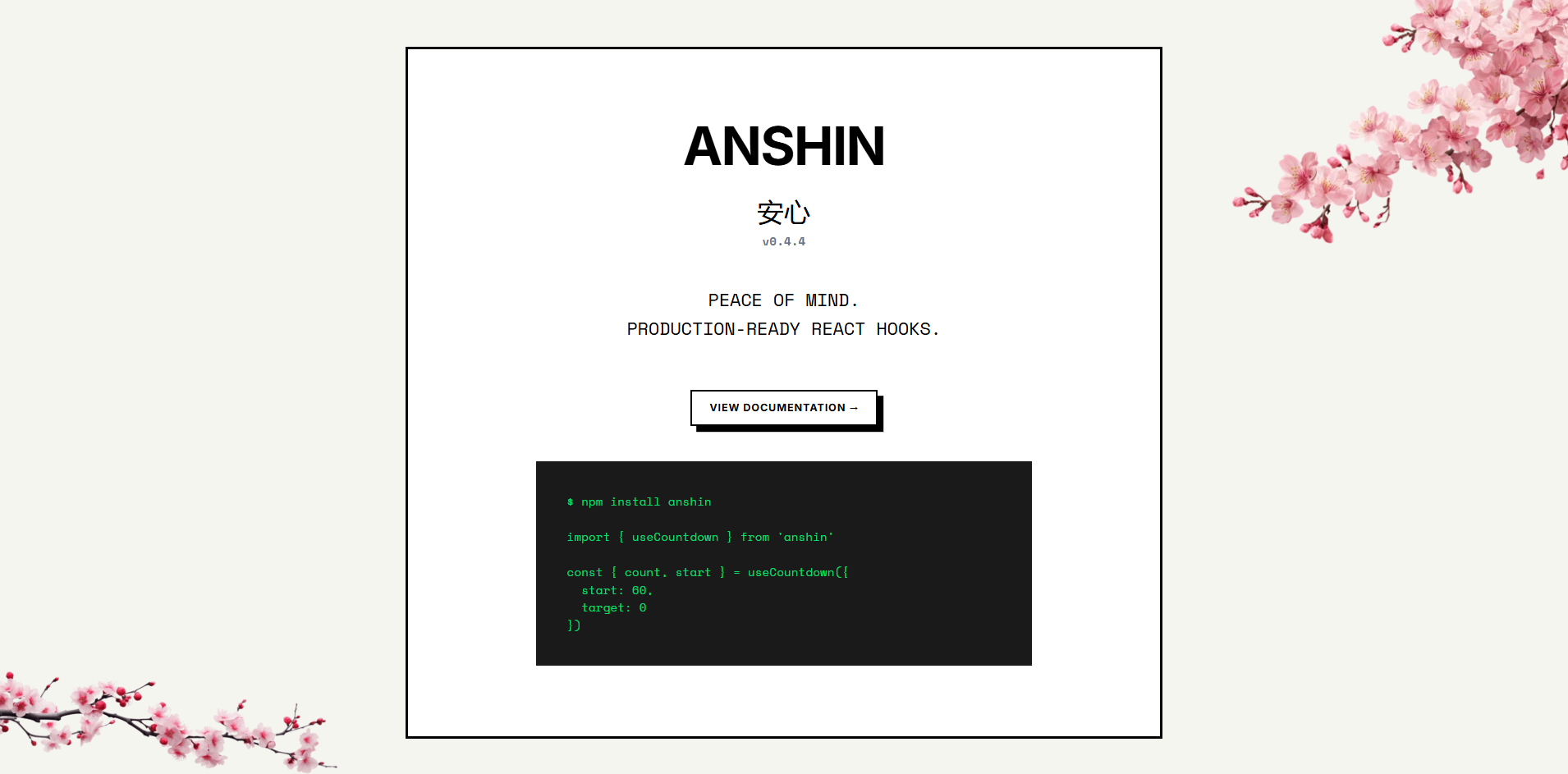
I named the library Anshin (安心) because it literally means “peace of mind”.
That is the feeling I want when I look at my code: the sense that things are handled and I do not need to constantly babysit edge cases.
The name then became a filter for every hook idea:
- Does this remove a class of bugs I have actually seen in real projects?
- Does it replace a messy block of
useEffectand callback spaghetti with something readable and predictable? - Will using this hook make a refactor less scary six months from now?
A hook in Anshin is not there to tick a checklist.
It is there because I felt the lack of it in a real codebase.
Building in a Saturated Market By Going Niche
Once I accepted that the generic hooks market was saturated, the strategy became simple: go niche and go deep.
Instead of trying to outdo existing “kitchen sink” libraries, I leaned into the problems that those libraries usually gloss over:
- Hooks that encapsulate tricky interaction and animation patterns that are hard to express with only CSS or one off logic
- Hooks that encode behavior over time: start, stop, delay, cancel, retry, coordinate
- Hooks that behave well in messy, real world component trees, not just perfect demo setups
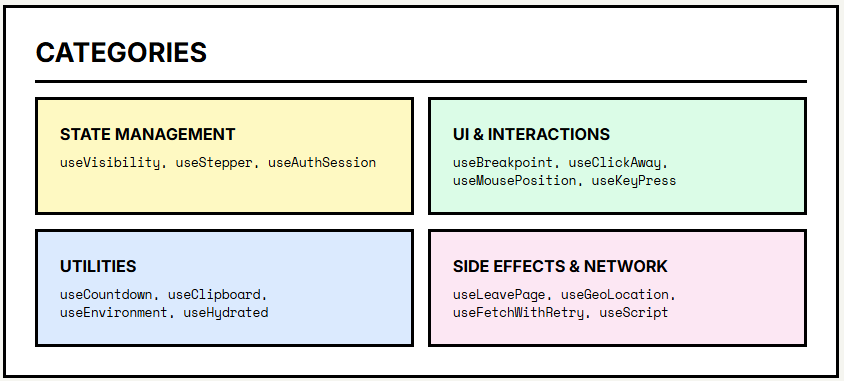
A lot of animation and interaction tools give you powerful primitives and then leave orchestration entirely to you.
Anshin aims to live a bit higher level and help you express “how it should behave” instead of just “what values are changing”.
This is also freeing from a product perspective.
I do not have to “win” the hooks library market.
I just have to be the best answer for a small set of recurring frontend headaches.
Hooks That Start As Scars
Almost every hook in Anshin started as ugly code in a real component.
The pattern usually looks like this:
- I hit a weird interaction requirement in a project.
- I solve it with a block of imperative logic that I am slightly ashamed of.
- The same need appears in another part of the app, and copy paste starts to feel dangerous.
- I extract a hook inside the project.
- If that hook proves stable, useful, and understandable, it “graduates” into Anshin with better typings and tests.
The hooks are not invented in isolation.
They are shaped by bugs, refactors, and “oh no” moments from real work.
By the time something lands in Anshin, it has already survived at least a couple of real situations.
What I Learned From Building a Niche Hooks Library
Focusing on niche, everyday frontend issues taught me a few things:
- You do not have to be broad to be valuable.
- Differentiation matters more than coverage.
- Real world scars are a feature, not a bug.
- Developer experience includes emotional state.
Where Anshin Fits In Your Stack
Anshin is not trying to replace the generic hooks you already use.
If you like your current library for things like debouncing or local storage, keep it.
Think of Anshin as a specialized layer you reach for when you catch yourself thinking:
- “I have written this interaction logic before, and I did not enjoy it.”
- “This
useEffectblock is doing way too much, and I am scared to touch it.” - “This animation or sequence works now, but it feels fragile.”
And if it gives you even a little bit of that “安心” feeling in your UI, that is exactly why it exists.